I study the ecology of natural populations' responses to environmental change across space and through time.


My dissertation focuses on how local and range-wide drivers shape the occupancy and abundance patterns of a federally threatened, annual plant endemic to granite outcrop pools in the southeastern United States, Gratiola amphiantha, or snorkelwort.


Listen to me geek about my work on this podcast episode:
In Defense of Plants, Ep. 472 - Snorkelwort & Friends are X-Treme!
How does imperfect detection bias our estimates of cryptic plant occupancy?
Imperfectly detecting species presence in the field can lead to underestimates of species’ abundance and distribution. This is well-known in animal systems but is under acknowledged in plant systems. Based on a literature review of all papers with published detection probabilities for plants, we found that cryptic plants (annuals with seed banks, geophytes, and deciduous perennials) are more likely to be imperfectly detected than non-cryptic plants.
Based on a case study utilizing occupancy models, we then found that snorkelwort has a relatively high detection probability, despite being cryptic as an annual plant relying on a seed bank. However, even with a high detection probability, snorkelwort occupancy was underestimated when it was not accounted for, demonstrating the consequences of ignoring this bias.
We found soil depth to be a strong predictor of snorkelwort occupancy, compared to other microhabitat characteristics.

This work was recently accepted in Ecology and we are awaiting a DOI to share!
This is my first dissertation chapter.


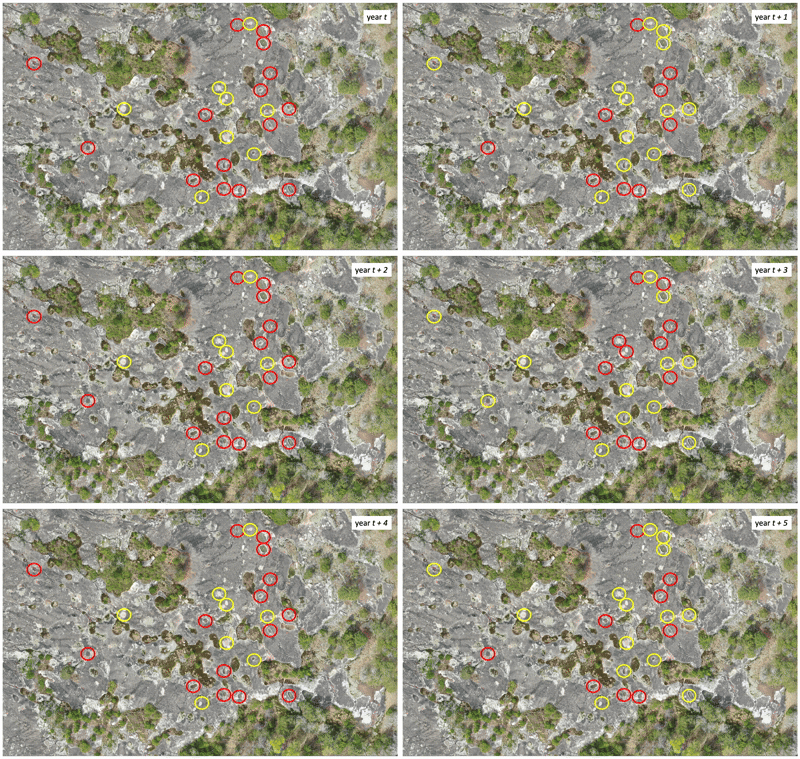

How do metapopulation dynamics change across the distribution of a naturally patchy plant species?
A metapopulation is a population of spatially isolated subpopulations that persist, as a whole, with dispersal between subpopulations. The presence (yellow) or absence (red) of the species in any one subpopulation may vary across years, making the colonization and extinction rates of subpopulations critical to understanding the metapopulation dynamics. Snorkelwort, endemic to naturally isolated granite outcrop pools, provides an excellent opportunity to explore metapopulation dynamics in an annual plant system.
With annual surveys of pool occupancy, I am quantifying the rates and drivers of colonization and extinction as well as the range-wide metapopulation dynamics of this rare species.
This work is the focus of one of my dissertation chapters.
How does density dependent population growth change across climatic niche gradients, with microhabitat characteristics, and across a species' range?
Scientists have long sought to understand what limits species' distributions, leading to canonical hypotheses that emphasize declining niche suitability and reduced habitat availability toward range edges. Yet empirical tests that integrate these hypotheses to explain range-wide patterns of abundance and occupancy remain rare. Using annual, range-wide surveys of the federally threatened snorkelwort, I test how local microhabitat feature and broader abiotic (environmental and spatial) factors jointly shape abundance, population growth, and occupancy.
This work is the focus of one of my dissertation chapters.


How does a dormant seed bank influence snorkelwort's long-term occupancy?
Seed banks can remain dormant in the soil for many years, complicating our estimates of species’ abundance and distribution. While there’s a growing literature incorporating seed banks into demographic models and estimates, it remains understudied and largely theoretical.
I’m pairing observational studies of snorkelwort seed bank dormancy with 15+ years of historic data on observed pool occupancy, to parameterize a multi-state hierarchical model to understand the role of dormant seed banks in species’ occupancy patterns.
This work is the focus of one of my dissertation chapters.
What is the long-term success of granite outcrop habitat enhancement efforts?
The U.S. Fish & Wildflife Service, with many partners, has completed a number of granite outcrop pool enhancement projects aimed at increasing populations of two federally endangered quillworts, Isoetes melanospora and Isoetes tegetiformans. Working with partners, we synthesized these efforts into a comprehensive USFWS official report.
To assess the long-term success of these projects which began in the 1980s, I surveyed persisting Isoetes populations to assess current abundance and habitat quality. We then compared the abundance of enhanced pools to nearby natural pools to assess long-term ecological establishment.
With collaborator J. Mincy Moffett, we recently submitted this manuscript to Ecological Restoration. We are excited to share soon!
_edited.png)


What kinds of data are most utilized by plant conservationists and what kind of data is most often published for protected plant species?
As part of an NSF grant across institutions, I along with another co-lead graduate student, are conducting a large-scale study in the southeastern United States to better understand the kinds of data used and needed by plant conservationists, as well as the kinds of data published on protected plant species, and the kinds of data required to remove plants from protected status. Our goal is to identify ways to strengthen the connection between research and active, applied conservation efforts.